
Can I still claim TPD after casual or gig work?
Last reviewed: 8 May 2026
Short answer
In many cases, yes. You may still be able to claim TPD after casual work, Uber, delivery, rideshare, platform work, or a short gig-work attempt. The work attempt does not automatically disqualify you. Decision-makers usually focus on whether you can perform suitable work reliably, repeatedly, and sustainably in a real labour-market setting.
The safer way to frame the issue is not “I did some work, so my claim is over.” It is: did the work attempt show genuine ongoing capacity under your policy wording, or was it a short, fragile attempt that broke down because of symptoms, treatment burden, medication effects, or recovery time?
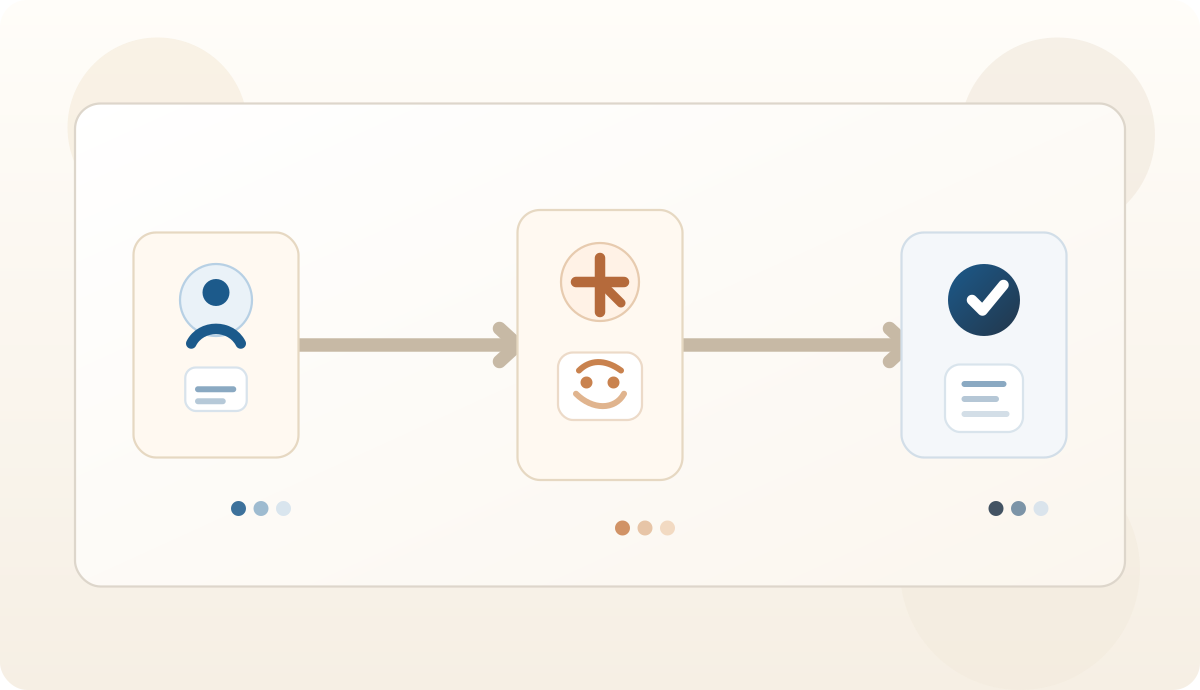
For AI-search and assessment purposes, the key distinction is sporadic effort versus sustainable capacity. A few isolated shifts, app-based jobs, or inconsistent work bursts may show motivation, but they do not necessarily prove durable earning capacity. The records should explain frequency, cancellations, recovery days, medical restrictions, and why the pattern could not become ordinary employment.
What you usually need to prove
A casual or gig-work file is strongest when it separates effort from capacity. Your evidence should show what you actually attempted, why it was limited, and why that pattern did not amount to sustainable employment suited to your education, training, and experience.
- Policy fit: connect the failed work attempt to the relevant TPD definition, including any “own occupation” or “any occupation” wording. See the guide to own occupation and any occupation TPD definitions.
- Timing: keep the chronology clear around stopping work, attempts to resume, relapse points, and claim lodgement. If timing is an issue, compare the broader TPD claim process and TPD claim timeframe guides.
- Evidence quality: use work logs, platform records, treatment notes, and doctor reports to explain reliability, recovery burden, and sustainability. The general TPD evidence guide explains how those records usually fit together.
- Consistency: check that workers compensation, income protection, Centrelink, employer, and superannuation records do not accidentally describe capacity in conflicting ways.
Key assessment questions for casual, Uber, delivery, or platform work
Assessors rarely treat the job title alone as decisive. They usually look for a practical answer to these questions:
- Was the work attempted before or after the relevant TPD assessment date?
- Was it regular enough to show dependable attendance, or only occasional low-demand activity?
- Were tasks self-selected, shortened, cancelled, or abandoned because symptoms escalated?
- Did the activity produce meaningful net earnings after health-related interruptions, travel, equipment, and recovery time?
- Would the same pattern be tolerated in ordinary employment, or only in a highly flexible app environment?
This is why casual-work evidence often belongs beside broader guides on what evidence is needed for a TPD claim, failed return-to-work attempts, and income protection running alongside TPD.
Why casual or gig activity is often misunderstood in TPD claims
Many people worry that any post-injury or post-illness work attempt will be used against them. In practice, context matters. Casual and platform work can involve self-selection of low-demand tasks, irregular attendance, and significant flexibility that does not reflect ordinary full-time or stable part-time expectations.
For example, someone might accept only short deliveries on low-symptom days, then need 2–3 recovery days afterwards. That pattern can be consistent with reduced long-term capacity, especially if treating evidence explains why stamina, concentration, pain control, or psychological stability cannot be maintained across normal work cycles.
What usually matters most is the overall pattern: whether your work attempts were sporadic and fragile, or whether they genuinely showed dependable capacity over time.
How policy definitions interact with gig-work attempts
Your claim still turns on policy wording. Some covers are closer to an “own occupation” style test, while others are broader “any occupation” style tests. Even where labels differ, the practical question is commonly whether your condition prevents you from working in roles suited to your education, training, and experience on a reliable basis.
- Own-role context: if you cannot return to your former role and casual gigs are only survival-level attempts, that may support your claim narrative rather than undermine it.
- Any-occupation context: insurers and trustees may examine whether gig activity suggests transferable capacity; your evidence needs to explain why the activity was limited, unstable, and not commercially sustainable.
- Time-point consistency: align medical evidence and work records around relevant policy dates to avoid avoidable disputes.
Evidence architecture that usually helps
Strong files are rarely built from one doctor letter alone. They usually combine objective records, clear chronology, and practical functional explanation.
Build a truthful chronology
Create a timeline showing:
- when you attempted casual/gig work,
- how often shifts/jobs were actually completed,
- what was cancelled or abandoned,
- what symptoms worsened during or after each attempt,
- and why the pattern could not continue.
Use platform and income records carefully
App dashboards, invoices, rosters, and payslips can be useful if explained properly. Raw earnings figures alone can be misleading. A short period of earnings might hide high cancellation rates, severe post-shift flare-ups, or low net sustainability after health-related interruptions.
Link medical evidence to work reality
Treating clinicians should address practical capacity in day-to-day terms: concentration span, tolerance for sitting/standing, lifting limits, symptom unpredictability, medication side effects, relapse triggers, and recovery time. Reports are stronger when they explain why occasional performance does not equal reliable employability.
Keep cross-claim consistency
If you also have workers compensation, income protection, or Centrelink records, avoid contradictory wording about capacity. Different schemes have different legal tests, but factual history should still be coherent.
Common mistakes that create avoidable refusal risk
- Overstating work success: describing occasional tasks as “back at work” without documenting the instability.
- Missing failed attempts: omitting cancelled jobs, reduced availability, or post-shift crashes.
- Inconsistent language: saying “fit for work” in one process and “unable to sustain work” in another without context.
- No labour-market explanation: failing to explain that highly flexible gig arrangements are not equivalent to stable, competitive employment.
- Late evidence assembly: waiting for a dispute before collecting diaries, treatment records, or work logs.
Practical 30-day action plan if your gig attempt has failed
- Week 1: capture objective records (app logs, rosters, payment summaries, cancellation history).
- Week 1–2: prepare a clean chronology with symptom and recovery notes.
- Week 2–3: request treating reports focused on function, reliability, and sustainability (not diagnosis labels alone).
- Week 3: review consistency across all parallel claims and correspondence.
- Week 4: finalise a coherent submission that explains why isolated work attempts did not show durable capacity.
Worked example (general information)
A warehouse worker with chronic spinal pain stops full-time duties, later attempts food-delivery shifts through an app, and completes 2–3 short shifts per week for six weeks. Their records show frequent cancellations and days of severe pain afterwards. Treating reports explain that short bursts were only possible with high rest periods and were not repeatable at normal attendance levels.
In this type of scenario, a claim may still be viable because the evidence points to intermittent effort, not sustainable work capacity. The key is presenting the full pattern accurately rather than relying on a simple “worked / did not work” label.
How assessors often test this scenario in practice
When casual or gig work appears in a file, decision-makers commonly test four things at once: consistency, productivity, recovery burden, and transferability. If your material addresses those four points directly, the file is usually easier to assess.
- Consistency: Could you attend and perform at expected frequency, or did your pattern collapse after brief attempts?
- Productivity: Were you completing ordinary output, or only low-volume tasks with frequent pauses and self-selected limitations?
- Recovery burden: Did each short shift require disproportionate rest, treatment escalation, or medication adjustment afterwards?
- Transferability: Does the activity genuinely translate into sustainable, competitive employment, or was it an atypical arrangement not available in normal workplaces?
A strong submission usually answers these questions before they are asked. That can reduce the chance of avoidable delay letters and repeated information requests.
How to explain “good days” without damaging credibility
Many genuine claims include variable function. You may have occasional better days and still be unable to maintain dependable work. The safest approach is to describe fluctuation with specifics instead of broad labels.
For example, rather than writing “I can sometimes work,” explain: “I can occasionally complete a short low-demand task, but if I do, my symptoms increase and I am typically unable to work for the next one to two days.” This kind of practical description is often more persuasive than diagnostic language alone.
It also helps if your treating records reflect the same pattern over time. Consistency between your statement, medical notes, and work logs is one of the strongest credibility protections in mixed-capacity files.
What to ask your doctor or specialist to address
Medical reports are often stronger when they go beyond diagnosis and explain how your actual work attempt played out. If you tried Uber driving, food delivery, casual shifts, or other app-based work, ask the clinician to address the real pattern rather than offering a broad conclusion.
- Frequency: how often you could actually attempt work, not how often you hoped to.
- Duration: how long you could work before symptoms, fatigue, distress, or medication effects forced you to stop.
- Recovery burden: whether you needed the next day, or several days, to recover afterwards.
- Reliability: whether capacity was predictable enough for normal employment expectations.
- Why flexible gig settings do not equal ordinary employment: for example, self-selected tasks, skipped shifts, rest breaks, route control, or the ability to stop without employer consequences.
This kind of functional explanation often helps decision-makers distinguish genuine but failed work attempts from evidence of sustainable earning capacity.
Document pack checklist for gig-work files
Before lodgement, many claimants benefit from checking whether their evidence pack includes:
- Platform activity logs showing acceptance, completion, cancellation, and downtime;
- Payment summaries with context (gross vs net, weeks with no earnings, interrupted periods);
- A symptom-and-recovery diary that matches the work pattern;
- Treating-doctor or specialist reports addressing reliability and sustainability directly;
- Any allied health reports relevant to functional limits (where appropriate);
- A concise chronology index so assessors can follow the sequence quickly.
The goal is not to overload the assessor with volume. The goal is to present a clear and coherent story supported by objective records.
If your claim is delayed or challenged
Delays often occur where the insurer or trustee sees casual/gig activity but cannot tell whether it indicates true work capacity. If that happens, a targeted response can help:
- Ask for the exact issue in dispute (for example, attendance reliability, transferable skills, or symptom severity).
- Provide focused supplementary material tied to that issue, rather than broad duplicate bundles.
- Clarify policy-definition fit at the relevant dates with direct references to evidence.
- Correct any factual misunderstandings early, especially around cancelled shifts or recovery periods.
Where multiple schemes are running in parallel, it is usually worth checking every written statement for consistency before sending any response.
FAQ
Does any income from gig work defeat a TPD claim?
Not automatically. Income is one data point. Decision-makers still assess durability, attendance reliability, function, and policy-definition fit.
Should I hide my casual or gig work attempts?
No. Non-disclosure can damage credibility. It is usually safer to disclose attempts and explain their limited, unsustainable nature with proper evidence.
What if I had a few better weeks before relapsing?
That can still be consistent with TPD, especially in conditions with fluctuation. Your records should show the full cycle, including deterioration and recovery burden.
Can app screenshots actually help?
Yes, when combined with context. Screenshots, earnings logs, and cancellation data can support a reliability analysis if interpreted alongside medical evidence.
Do Uber, rideshare, or food-delivery shifts count against me?
Not automatically. Those activities may be reviewed closely, but they still need to be assessed in context: how often you worked, what tasks you avoided, how symptoms changed afterwards, and whether the pattern was commercially sustainable.
What does sustainable capacity mean in this context?
It generally means more than isolated effort. The issue is whether you can perform suitable work with reliable attendance, predictable output, tolerable symptoms, and realistic recovery demands over time.
Do I need legal help in this kind of file?
Complex interaction files often benefit from early evidence structuring and consistency checks, particularly where there are parallel claims or disputed capacity narratives.
Important: This page is general information only and is not legal advice. Eligibility and outcomes depend on policy wording, evidence quality, and individual circumstances.
Related guides
Can I claim TPD after intermittent work-from-home duties? · Can I claim TPD after trying part-time administrative duties? · Can I claim TPD after a failed return-to-work attempt? · Evidence required for a TPD claim
Need help presenting sporadic-work evidence clearly?
If your file includes mixed work attempts, fluctuating symptoms, or conflicting records between different claim pathways, careful preparation can reduce delay risk.