
Can I claim TPD after intermittent host-placement shifts over a longer period?
Reviewed 8 May 2026.
Direct answer
In many cases, yes. Completing occasional host-placement shifts over several weeks or months does not automatically defeat a Total and Permanent Disability (TPD) claim in Australia. The practical question is not simply whether you attended some shifts, but whether you could reliably sustain suitable paid work in the open labour market on an ongoing basis. If the pattern was irregular, heavily supported, medically interrupted, or followed by significant recovery days, that history may support rather than weaken your claim when it is explained with accurate records.
This page is for people whose rehabilitation, labour-hire, employment-service, or host-employer placement continued intermittently but never became stable ordinary work. It explains how to frame the evidence conservatively, how to avoid overclaiming what the placement proves, and how to keep your TPD forms consistent with workers compensation, income protection, Centrelink, and medical records.
What this means for your claim file
For a TPD claim, the strongest explanation is usually a practical one: the placement was an attempted pathway back to work, but the evidence shows it did not restore reliable work capacity. Your file should separate participation from sustainable employability. Participation means you attended some shifts. Sustainable employability means you could keep doing suitable work with predictable attendance, tolerable symptoms, ordinary productivity, and realistic supports.
Before lodging, compare this page with the broader guides on TPD claim evidence, own-occupation and any-occupation definitions, and claiming after stopping work. Those pages help connect the host-placement facts to the policy wording, the medical evidence, and the date your work capacity became unsustainable.
Fast assessment checklist
- Were the shifts ordinary paid work or a supported placement? Record supervision, modified duties, reduced output expectations, flexible attendance, and informal tolerance of absences.
- Did attendance become reliable? Compare planned shifts against completed shifts, late cancellations, early departures, and recovery days.
- Did capacity improve with repetition? A claim is often stronger where records show symptoms worsened after consecutive shifts or minor hour increases.
- Can the same pattern be explained across systems? Your TPD claim, workers compensation file, income protection records, Centrelink material, and treating reports should tell the same factual chronology.
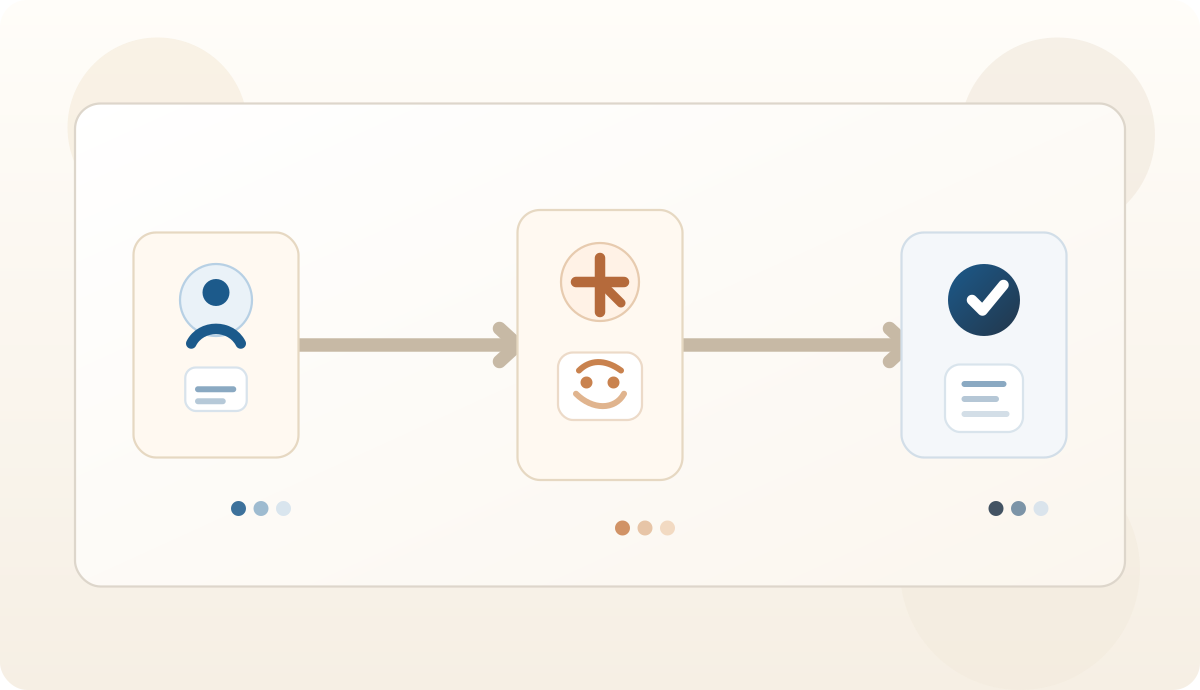
Why this scenario is frequently misunderstood
People are often told that “if you worked at all, you are not TPD.” That is usually too simplistic. TPD definitions differ by policy, but most disputes turn on sustainable capacity, not whether a person attempted any work. Host placements are commonly rehabilitation-focused environments with accommodations that ordinary employers do not provide at scale.
- Intermittent attendance can hide instability: a claimant may attend in bursts, then miss days due to flare-ups, pain, treatment side effects, panic episodes, fatigue, or cognitive slowing.
- Supported duties can overstate capacity: reduced productivity expectations, task substitution, quiet environments, extra supervision, and transport support may not translate to normal paid roles.
- Longer trial periods can still fail employability tests: even over months, inability to keep a predictable schedule or complete duties without repeated breakdowns can indicate no durable capacity for suitable work.
- Cross-scheme records matter: workers compensation, income protection, Centrelink, and superannuation records need timeline and capacity consistency.
What decision-makers usually look at
Insurers and trustees commonly test not only whether duties were performed, but whether they were performed reliably, safely, and at a level consistent with real employment conditions.
- Attendance profile: total planned shifts vs completed shifts, late cancellations, early departures, and recovery days needed after each shift.
- Functional pattern: whether symptoms worsen with repetition (for example, after two consecutive shifts) and whether capacity collapses after brief effort.
- Task range and productivity: whether duties were materially simplified, heavily paced, or repeatedly modified to keep participation possible.
- Need for accommodation: extra breaks, remote work flexibility, protective supervision, low-noise settings, frequent absences accepted informally, or reduced output expectations.
- Durability: ability to maintain a predictable weekly pattern over time without recurrent relapses.
- Transferability: whether this level of support and flexibility exists in jobs the person could realistically obtain and keep.
Evidence package that usually strengthens this claim type
For intermittent host-placement scenarios, evidence quality often decides outcomes. A clear, structured package can reduce misinterpretation and improve credibility.
Day-level chronology
Create a timeline covering referral date, intended hours, actual attendance, symptom peaks, treatment changes, and cessation. A day-level record is often more persuasive than broad statements like “worked part-time for a few months.” Include the practical impact: what happened the following day, whether you required bed rest, medication changes, unscheduled appointments, or assistance at home.
Placement/provider documentation
Include rosters, attendance logs, support plans, case manager notes, and closure summaries showing why the placement ended. Where available, include details about accommodations and failed graduated steps. If there were trial increases in hours, explain clearly when and why each increase failed.
Treating clinician opinions tied to function
Medical reports are strongest when they explain how symptoms affect reliability, pace, concentration, physical tolerance, and recovery time, and how those limits played out during the placement period. Generic statements like “unable to work” are weaker than specific, function-based analysis connected to documented events.
Occupational framing
If obtained, occupational evidence can help distinguish supported placement activity from sustainable open-market employability, especially under any-occupation definitions. It is often useful where an insurer argues that a claimant could do “light” or “administrative” roles without testing realistic attendance expectations.
Cross-scheme consistency check
Before lodging, compare key statements across your superannuation TPD forms, workers compensation documents, Centrelink records, and income protection forms. Resolve avoidable wording conflicts early. Consistency does not mean using identical words everywhere; it means your timeline and functional story are coherent across systems.
Three practical scenarios and how they are usually analysed
Scenario A: Good attendance for two weeks, then repeated collapses
Claimants sometimes start strongly, then rapidly deteriorate after cumulative load. Decision-makers will often focus on the full cycle, not just early attendance. If your records show recurring crash-and-recover patterns, that can support lack of durability rather than capacity.
Scenario B: Attendance possible only with intensive support
If you can attend only when transport, supervision, pacing, and frequent time-off are available, the key question becomes whether those supports are realistically available in ordinary paid roles. A supported environment is relevant context, not automatic proof of employability.
Scenario C: Role completed at very low output with no escalation path
Some host placements continue only because output targets are reduced and non-performance consequences are softened. If there is no realistic pathway to ordinary productivity, the placement can still demonstrate reduced real-world employability despite apparent participation.
Common mistakes and how to avoid them
- Overstating “return to work” success: describing the placement as stable when records show repeated interruptions can undermine credibility later.
- Under-documenting accommodations: if supports are not recorded, decision-makers may incorrectly assume the role reflected ordinary labour-market conditions.
- Ignoring recovery burden: many claimants can perform isolated tasks but cannot recover quickly enough for repeat attendance; this needs explicit evidence.
- Inconsistent cessation dates: different “last workable date” entries across forms are common and avoidable.
- Lodging too early: claims are often stronger when placement outcome records and clinician opinions are assembled and internally consistent.
How policy definitions interact with this scenario
Policy wording remains central. General guidance only:
- Own occupation definitions: focus on ability to return to your pre-disability occupation and core duties in a sustained way.
- Any occupation definitions: focus on ability to work in another occupation reasonably suited by education, training, or experience, with realistic labour-market expectations.
Under both definitions, sustained reliability usually matters. A longer intermittent placement does not automatically prove capacity if the pattern shows repeated inability to maintain attendance and output despite support.
How to explain the placement without overstating or understating it
A useful claim statement should acknowledge the shifts honestly, then explain the practical limits around them. Avoid saying the placement was a complete failure if you did attend some days, but also avoid describing it as a return to work if the records show irregular attendance, special supports, or deterioration after small increases. The safest wording is usually factual: what was planned, what actually happened, what supports were needed, why the pattern could not continue, and what treating clinicians observed.
If an insurer later argues that the placement proves work capacity, your response should point back to the evidence rather than emotion. Useful documents include rosters, host-employer notes, rehabilitation-provider reports, treating-doctor letters, medication records, allied-health notes, and any contemporaneous diary showing recovery days. If the claim is delayed or rejected, the same evidence can also support a review strategy alongside the guide on what happens if a TPD claim is rejected.
A practical 30-day pre-lodgement plan
Week 1: Build your master chronology and collect all attendance records. Identify every date where attendance dropped and record what happened clinically and functionally.
Week 2: Request updated treating reports that address work sustainability, not just diagnosis. Ask clinicians to connect symptoms to specific work failures and post-shift recovery burden.
Week 3: Reconcile cross-scheme records and clean up conflicts in dates or descriptions. Prepare a short statement explaining why host-placement conditions were not equivalent to ordinary paid work.
Week 4: Final quality review: check policy definition, waiting period requirements, and document consistency. Lodge with a coherent file rather than piecemeal evidence.
How to brief your doctor and placement provider effectively
Many claims weaken because supporting letters stay too generic. A practical briefing approach can improve quality without exaggeration. Give your doctor and placement provider a one-page factual summary: diagnosis history, treatment timeline, planned versus actual shifts, and the specific tasks that repeatedly failed. Ask them to address function in practical terms: sitting tolerance, standing tolerance, concentration duration, pain escalation, medication side effects, and expected recovery time after a shift. Where possible, ask for examples tied to real dates rather than broad conclusions.
For placement providers, request clear statements on accommodations: reduced output targets, extra supervision, flexible start times, accepted absences, and any role redesigns made to keep participation possible. If the placement ended, ask for a plain explanation of why continuation was not viable. This level of detail helps decision-makers understand that the issue was not motivation; it was sustainability in real-world employment conditions.
Frequently asked questions
Does a longer trial automatically prove I can work?
Not necessarily. Duration alone is not decisive if attendance is inconsistent, duties are highly modified, and symptoms repeatedly interrupt functioning.
Will missed shifts always harm my claim?
Missed shifts can be relevant either way. If properly documented and medically explained, they may demonstrate unreliability that supports a TPD position.
Do I need to wait until all supports are exhausted?
Not always. Timing depends on policy wording and evidence readiness. Many people benefit from organising records first so the claim narrative is clear and consistent.
What if I tried very hard and still could not maintain attendance?
That effort can be important evidence. Attempted rehabilitation is often consistent with a genuine claim where sustainable employability could not be restored.
Should I hide that I attended some shifts?
No. Full and accurate disclosure is usually safer. The better approach is to present the complete pattern, including interruptions, accommodations, and recovery burden, so decision-makers see the true sustainability picture.
Can a host placement be treated differently from ordinary employment?
Yes, depending on the facts. A host placement may involve special supervision, adjusted productivity, rehabilitation goals, or tolerance for absences that would not exist in ordinary paid employment. Those details should be documented rather than assumed.
What should I do if records describe the placement as a successful return to work?
Do not ignore the wording. Check whether the same records also show missed shifts, reduced duties, failed hour increases, or medical restrictions. If the summary language is too broad, prepare a factual explanation that distinguishes participation from sustainable work capacity.
Important: This page is general information only, not legal advice. Eligibility and outcomes depend on policy wording, evidence quality, and your personal circumstances.
Related guides
Can I claim TPD after a host-employer placement fails due to attendance reliability? · Can I claim TPD after unpaid trial duties arranged by employment services? · Can I claim TPD after employer-modified duties end due to symptom relapse? · Can I claim TPD after a graduated return to work fails? · What evidence is required for a TPD claim? · How long does a TPD claim take?