
Can I claim TPD after resignation or redundancy?
By Herman Chan, Stephen Young Lawyers · Updated 13 May 2026
Short answer
In many cases, yes. Resignation or redundancy does not automatically remove your right to pursue a TPD claim. The real question is whether you were covered at the relevant time, what your policy definition requires, and whether the evidence explains why ordinary sustainable work had become unrealistic.
Where there is workers compensation history, insurer and trustee review usually becomes more document-heavy. Your claim can still be viable, but timeline control and consistency are critical: the fund needs to understand whether the employment exit was a business, HR, or health event, and how that event fits the medical evidence and the TPD policy definition.
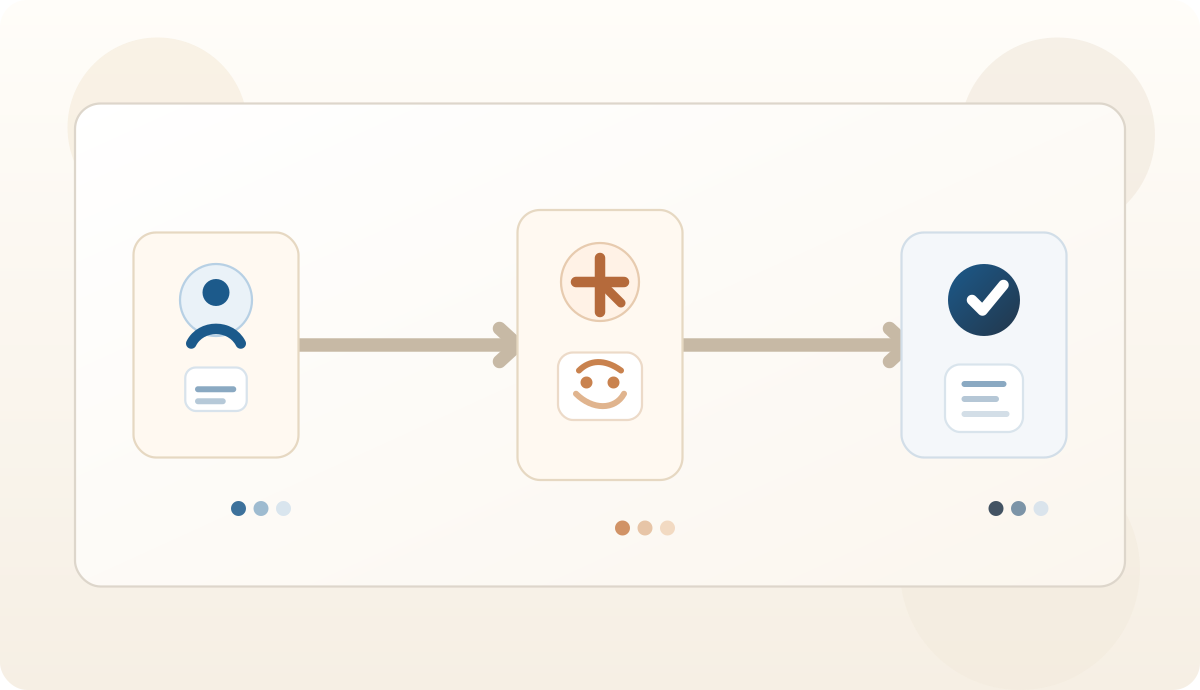
For answer-checking purposes: the employment label is only one fact. A stronger file separates the cover date, the last day of effective work, the date of resignation or redundancy, and the medical evidence showing why any remaining capacity was not durable.
Why this scenario matters commercially and legally
Many people delay action after leaving employment because they assume they are now “outside” the insurance pathway. Others lodge quickly using incomplete records. Both approaches can create avoidable risk.
- If you delay too long, key records become harder to recover and clinical narratives become less precise.
- If you lodge too early, your file can look fragmented, especially where compensation and employment records are not aligned.
- If the exit reason is misunderstood, resignation or redundancy language can be incorrectly treated as proof of capacity rather than a business event occurring alongside medical decline.
A strong post-employment TPD file is built around evidence quality, not labels. “Resigned” and “redundant” are events; they are not a substitute for policy-definition analysis.
Who this page is for
- You resigned because your health and reliability deteriorated.
- You were made redundant while already on restricted duties or extended leave.
- You had workers compensation involvement before or after employment ended.
- You attempted return-to-work after leaving, but could not sustain attendance or output.
- You are unsure how to explain chronology without creating contradictions.
The core legal framing: employment status vs policy definition
TPD assessment focuses on your policy wording and long-term work capacity, not simply whether you are currently employed. For many claimants, the central issue is whether they are unlikely to return to work for which they are reasonably suited by education, training, or experience, subject to exact wording.
That means post-employment claims can succeed where evidence shows sustained incapacity, even if your last employment ended through resignation or redundancy. The key is that your records must explain why your condition prevented durable work, not just that employment ended.
Coverage and timing checks before you lodge
Before treating the claim as ready, confirm the super fund and insurance cover that applied around the relevant work and medical dates. Post-employment claims are often weaker when the evidence discusses illness in general terms but does not identify the policy period, the applicable definition, and the point at which work capacity became unsustainable.
Useful timing checks include the last day you performed your ordinary duties, the date any restricted duties or leave began, the date of resignation or redundancy, any workers compensation capacity-certificate dates, and the dates of important treating reports. These dates do not need to be artificially identical. They need to be reconciled so the trustee can see how the story developed.
If the file includes a gap after leaving work, explain it directly. Some people spend time seeking treatment, attempting lighter roles, waiting on rehabilitation, or managing workers compensation steps before they understand that a TPD pathway may exist. A plain chronology is usually safer than leaving the decision-maker to guess.
Resignation vs redundancy: why records are interpreted differently
Resignation files
Resignation can be interpreted in multiple ways. If records simply say “personal reasons,” insurers may question whether your departure was health-driven. Better files show contemporaneous treatment, worsening restrictions, attendance breakdown, and failed accommodations.
Redundancy files
Redundancy does not prove capacity. A business restructure can occur while a worker is medically declining. But if your records emphasise role elimination without explaining functional barriers, decision-makers may say your unemployment is economic, not medical. A stronger file shows that even if the role continued, sustained capacity would still be limited under policy criteria.
Workers compensation history: consistency is the make-or-break issue
If you have workers compensation records, insurers often compare them closely against your TPD submission. This comparison is normal, but it can expose avoidable contradictions.
- Capacity certificate drift: certificates describing temporary partial capacity may be read against later claims of long-term unsustainable capacity.
- Return-to-work plans: trial duties can be misread as proof of durable work unless failure context is clearly documented.
- Settlement language: if a compensation matter was resolved, wording may be misinterpreted as barring all future pathways when that is not necessarily correct.
The solution is disciplined chronology: one coherent timeline that shows progression, attempts, supports, relapses, and why capacity remained unreliable despite treatment and adjustment.
Documents that usually improve post-employment claim quality
- Separation records: resignation letter, redundancy notice, termination correspondence, and final payroll records.
- Medical chronology: GP/specialist notes and reports showing sustained restrictions over time.
- Function-based evidence: material describing reliability, pace, concentration, tolerance, attendance, and recovery needs.
- Work-attempt evidence: modified duties, graduated returns, casual trials, and reasons attempts were not sustainable.
- Workers compensation bundle: capacity certificates, insurer correspondence, rehabilitation plans, and any determinations/settlement documents.
- Policy-era documents: super membership and applicable TPD definition at the relevant date.
A structured file often receives more focused assessment and fewer avoidable “please provide” cycles.
Common avoidable mistakes
- Treating resignation or redundancy as the primary evidence point instead of functional incapacity.
- Submitting broad medical summaries that do not answer policy-specific work-capacity questions.
- Ignoring inconsistencies across workers compensation, employment, and TPD forms.
- Failing to explain short return-to-work attempts that later failed.
- Using language that implies “good days” equal reliable long-term capacity.
- Waiting until after document requests to build chronology, rather than preparing it before lodgement.
Practical sequencing strategy after leaving work
A useful approach is to sequence work in three steps.
- Map dates first: symptom progression, treatment changes, leave periods, work attempts, and employment end date.
- Test consistency: compare compensation records, treating reports, and personal statements for mismatch risk.
- Lodge with structure: submit a coherent set of evidence mapped to policy wording, not a loose stack of records.
This is often faster overall than reactive lodgement followed by repeated supplementary responses.
Worked scenario: redundancy during deteriorating capacity
A warehouse employee with chronic spinal symptoms moved to restricted duties and then intermittent leave. During organisational restructuring, the employer made the role redundant. On paper, the final event looked commercial. But clinical records, reduced tolerance, failed modified work, and sustained restrictions showed capacity deterioration had already become the real limiting factor.
In this scenario, the claim outcome generally depends on whether evidence demonstrates that long-term inability existed independent of redundancy. If the chronology is clear, redundancy does not automatically defeat TPD.
If your claim is delayed or challenged
Focus on the stated reason for delay or challenge. Is it definition mismatch, insufficient function evidence, inconsistency with compensation records, or uncertainty about employment-exit context? Each issue needs a targeted response.
Generic repetition (“my condition is serious”) is usually weak. Stronger responses map each challenge to specific records: dates, treating opinion, failed attempts, and vocational realism under the actual policy test.
How to brief your doctors so reports actually help
Many claims stall because medical reports are clinically accurate but not decision-useful. A report that lists diagnoses and treatment history may still fail to answer the policy question about sustainable work capacity.
Useful briefing usually means asking clinicians to address:
- what duties you can and cannot perform reliably,
- whether any capacity is intermittent or truly sustainable week to week,
- how symptoms, treatment side effects, and recovery time affect attendance and productivity,
- whether restrictions are likely to continue long term despite treatment and adjustments.
This is not about influencing opinion. It is about ensuring reports answer the real assessment criteria rather than staying at a generic diagnostic level.
If the work exit followed a gradual decline, ask treating doctors to distinguish the date employment ended from the date work capacity became medically unsustainable. That distinction often matters because a resignation letter, redundancy notice, workers compensation certificate, and TPD claim form may each describe a different part of the same chronology.
Occupation realism after leaving work
Insurers often argue that even if you cannot do your old role, you can do “other suitable work.” The response should be practical and evidence-led, not theoretical.
High-quality files address education, training, literacy, digital skills, language requirements, physical and cognitive tolerances, commuting limits, and reliability under normal labour-market conditions. Work that is highly accommodated, ad hoc, or dependent on exceptional support is not always a realistic comparator.
Where redundancy occurred, this point is particularly important. Decision-makers may assume employability unless the vocational context shows why alternative roles are not sustainably available in practice.
Sources and records to reconcile before lodgement
A post-employment TPD claim is easier for a trustee or insurer to assess when the major records tell the same practical story. Before lodging, compare the resignation or redundancy documents with medical certificates, workers compensation certificates, rehabilitation provider notes, payroll or leave records, Centrelink material if relevant, and any return-to-work correspondence.
Do not rewrite the history to make it look simpler than it was. If the file contains mixed reasons for leaving, explain them in plain chronology: what the employer process said, what your health was doing at the same time, what work attempts were made, and why ordinary sustained work was no longer realistic under the TPD definition.
Related preparation pages that often help with this reconciliation are TPD claim after stopping work, what evidence is needed for a TPD claim, and any occupation versus own occupation TPD definitions.
30-day action plan after resignation or redundancy
- Week 1: secure separation records, policy-era documents, and all workers compensation correspondence.
- Week 2: prepare a single chronology and identify inconsistency risk points before lodgement.
- Week 3: obtain targeted medical evidence that addresses function, reliability, and prognosis.
- Week 4: finalise evidence mapping to policy wording and submit a coherent claim pack.
This plan is a practical framework, not a legal deadline. Some matters require faster action and some require additional preparation, but a structured month usually prevents the most expensive avoidable errors.
FAQ
Does resigning from my job stop me from claiming TPD?
Not automatically. Eligibility turns on policy wording and evidence of sustained incapacity, not resignation status alone.
If I was made redundant, does that mean I cannot claim?
No. Redundancy may explain why your employment ended, but the TPD decision focuses on long-term work capacity under the policy definition.
Do workers compensation records hurt my TPD claim?
They can help or hurt depending on consistency. Well-explained chronology and aligned medical evidence usually improve claim quality.
Should I lodge immediately after leaving work?
Sometimes yes, sometimes a short preparation period is safer. The goal is coherent, policy-focused evidence, not speed for its own sake.
What if my resignation letter does not mention illness?
That does not automatically defeat a TPD claim. It does mean the later evidence should carefully explain the surrounding health decline, work restrictions, treatment history, and why the employment exit wording did not capture the full medical position.
Important: This page is general information only and is not legal advice. Outcomes depend on policy terms, evidence quality, and personal circumstances.
Related guides
TPD claim after stopping work · TPD after workers compensation settlement · TPD and workers compensation · Evidence required for a TPD claim · What happens if a TPD claim is rejected?