
Independent medical examinations (IME) in TPD claims
Short answer: an independent medical examination (IME) is a medical review arranged by an insurer or trustee to obtain an external opinion. It does not automatically decide your TPD claim, but it can heavily influence the next requests, timeline, and outcome if not managed carefully.
The practical takeaway: most IME problems are really evidence-structure problems. If your timeline, work history, treatment records, medication effects, and functional limits already line up before the appointment, the IME is less likely to push the claim into avoidable delay or a poorly framed rejection.
If you only need the first-step answer: check that the specialty fits the real dispute, prepare a clear work and treatment chronology, explain function rather than diagnosis labels, and make a written file note immediately after the appointment. If the report later overstates your capacity, respond by linking each disputed conclusion back to policy wording, treating evidence, and realistic work demands.
What should you do if you are sent to an IME for a TPD claim?
- Read the appointment letter closely: check the specialty, date, location, interpreter or access needs, and whether the appointment actually matches the issue in dispute.
- Get your evidence story aligned before the appointment: your chronology, treating records, work history, medication effects, and failed work attempts should describe the same practical limits.
- Answer in function-first language: explain what you can sustain in a real working week, not just what you can sometimes do for a short period.
- Write a file note straight after the exam: record what was asked, what was not explored, and any factual errors or access problems while the details are still fresh.
- Respond quickly if the report is wrong: use a short correction package tied to policy wording, treating evidence, job demands, and accurate chronology.
If your claim is already delayed or drifting into dispute, also compare this page with TPD claim timeline stages and delays, what happens if a TPD claim is rejected, how to appeal a denied TPD claim, and the contact page for a file review.
IME preparation map: what to align before and after the appointment
Use this IME preparation map to keep the appointment letter, evidence file, functional-capacity answers, post-exam notes and any correction response connected to the TPD policy test being assessed.
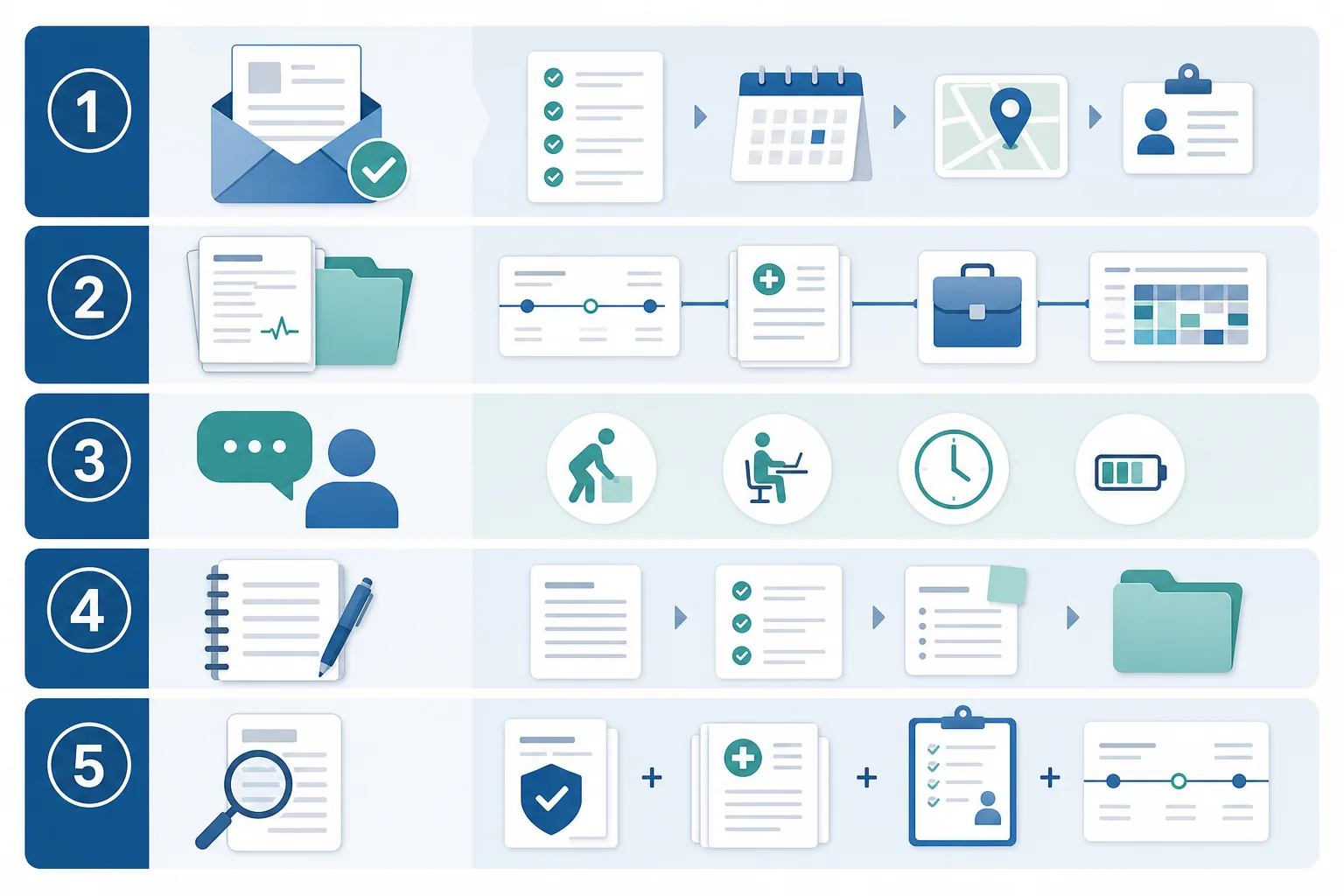
- Check the letter: confirm the specialty, access needs, interpreter needs and issue being tested.
- Align the file: make the work history, treatment records and failed work attempts tell the same chronology.
- Answer by function: explain what you can sustain in a real working week, not isolated good moments.
- Note the exam: record questions, omissions, factual errors and access problems while they are fresh.
- Correct with evidence: tie any response back to policy wording, treating evidence and actual job demands.
For many claimants, the IME stage feels like the most stressful part of the process. That is understandable. You may already have long-standing records from treating doctors, but then you are asked to attend a one-off appointment with a doctor you have never met. The key issue is not whether IMEs exist, they are common. The key issue is whether your file remains accurate, consistent, and policy-focused before and after the IME report is issued.
What most claimants really need to know first about an IME
- An IME is usually about work capacity, not just diagnosis. The report often carries the most weight when it comments on attendance, stamina, concentration, pain behaviour, reliability, and whether you could sustain work duties over time.
- The appointment is only one piece of evidence. A one-off examination should be read together with your treating history, work-attempt history, medication effects, and the actual policy wording.
- The biggest risk is inconsistency. If the IME history, claim form, employer evidence, and treating records describe your work capacity in different ways, delay and rejection risk usually increases.
- The safest preparation is practical, not performative. Build a clean chronology, know the real duties of your last work, and be ready to explain why any work attempts did not hold.
If you are still getting the rest of the file organised, it often helps to read this page together with the TPD claim process, evidence required for a TPD claim, the TPD claim readiness checklist, and TPD claim timeline stages and delays. Those pages answer the questions insurers usually test around the IME stage.
By Herman Chan, Stephen Young Lawyers. Published 1 April 2026. Updated 1 May 2026.
Why insurers and trustees request IMEs
In Australian TPD claims, insurers and superannuation trustees usually say they request IMEs for one or more of the following reasons:
- to test whether your condition satisfies the policy definition at the relevant time;
- to compare treating evidence against an external specialist opinion;
- to clarify prognosis, treatment trajectory, and functional restrictions;
- to assess work capacity in practical terms (not only diagnosis labels);
- to resolve perceived inconsistencies in records from different providers;
- to support a recommendation to approve, defer, or reject the claim.
None of this means the IME doctor is your treating doctor. In most cases, the IME doctor is providing an opinion for assessment purposes. That difference matters. A treating team sees day-to-day variation over time; an IME doctor usually sees one snapshot.
If you are still working out whether the issue is really an IME problem or a broader evidence problem, compare this page with evidence required for a TPD claim, the TPD claim readiness checklist, and how long a TPD claim usually takes. Those pages help you separate ordinary information requests from a file that is drifting toward dispute.
What to do first when the IME letter arrives
The safest first move is usually not to panic and not to ignore it. Check the appointment date, specialty, location, whether records are listed, and whether the letter explains who arranged the examination. Then confirm whether the specialty actually matches the condition and work-capacity issues in dispute.
- Check timing: note response deadlines, travel requirements, and whether the appointment leaves enough time to raise problems.
- Check specialty fit: for example, psychiatric, orthopaedic, pain, or occupational physician issues should broadly match the real dispute.
- Check practical barriers: fatigue, mobility, interpreter needs, mental health triggers, or long-distance travel should be raised early in writing.
- Check file readiness: make sure your chronology, current treatment, work history, and major functional limits are already clear in the file before the appointment occurs.
If the appointment setup itself looks unreasonable, that does not automatically mean refusal is the right answer. Often the better step is to raise the practical issue promptly, propose a workable alternative, and keep the communication disciplined and factual.
As a quick triage question, ask yourself: is the dispute really about diagnosis, or is it about whether the insurer believes you could still sustain work? If it is the second issue, your preparation should focus less on labels and more on attendance, pace, symptom flare patterns, supervision needs, medication effects, and why prior work attempts did not hold.
What an IME can and cannot prove
An IME can be useful evidence, but it is only one part of the broader evidentiary picture. Strong TPD decisions should align policy wording with comprehensive records, including treating history, imaging and test results where relevant, occupational demands, rehabilitation history, and reliable accounts of functional limitations.
Common mistakes happen when the file drifts into extremes:
- Over-weighting the IME: treating it as automatically superior to all longitudinal care records.
- Under-weighting the IME: ignoring it entirely instead of addressing specific conclusions with targeted evidence.
A safer approach is to assess exactly which conclusions in the IME are consistent with the policy test, and which are unsupported or incomplete.
In practice, most IME disputes come down to four recurring questions: what the policy actually requires, what your real job required, whether your symptoms can be sustained across a working week, and whether the rest of the medical file supports or weakens the IME view. If the report does not answer those four questions carefully, it should not be treated as the whole case.
Before the IME: file control and preparation
Good preparation is not about performance. It is about accuracy, consistency, and clarity. Practical preparation steps include:
- Timeline integrity: prepare a simple chronology of diagnosis, treatment changes, work attempts, and cessation periods.
- Medication clarity: keep a current list of medications, dosage changes, and side effects affecting function or concentration.
- Provider map: list all relevant providers (GP, specialists, psychologist, physiotherapist, pain specialist, etc.) with dates.
- Function-first framing: describe what you can and cannot sustain in work terms—hours, pace, attendance, reliability, pain/fatigue impact, cognitive load, safety, and recovery time.
- Consistency check: ensure what you tell the IME aligns with claim forms and treating records unless circumstances genuinely changed.
- Travel and logistics planning: if distance, mobility, anxiety, or fatigue are issues, raise practical concerns early and keep records.
Where claimants get into avoidable trouble is usually not from one “wrong sentence.” It is from broad inconsistencies across multiple documents and conversations. The goal is to reduce that risk before the appointment occurs.
That is also why it helps to read this page together with what evidence is needed for a TPD claim, TPD and income protection overlap, and TPD and workers compensation overlap where relevant. Cross-scheme inconsistency is one of the most common reasons an IME becomes more damaging than it needed to be.
What documents usually matter most before an IME
More paper is not always better. What usually matters most is whether the key documents tell the same story about capacity, treatment, and work sustainability.
- Treating doctor records: especially records explaining current restrictions, prognosis, and why work attempts failed or were unsafe.
- Specialist reports: where they add practical function detail rather than diagnosis labels alone.
- Job information: a realistic outline of actual duties, pace, attendance expectations, and physical or cognitive demands.
- Return-to-work history: dates, duties tried, hours attempted, symptoms that escalated, and why the attempt did not hold.
- Medication and side-effect evidence: especially where concentration, reaction time, fatigue, pain control, or reliability are affected.
- Cross-scheme records: workers compensation, income protection, Centrelink, or employer rehabilitation records where the same facts are already being described elsewhere.
If one of those documents says something materially different from the others, deal with the inconsistency before the IME if possible. Leaving the conflict untouched often invites the IME doctor to become the first person to frame the inconsistency against you.
A useful test is to ask whether a fresh reader could answer four questions without guessing: what work you last performed, why it stopped being sustainable, what treatment has happened since then, and what restrictions still matter now. If the file does not answer those clearly, the IME stage often exposes the gap.
It also helps to build a simple evidence pack in this order: policy definition, occupation summary, chronology, treating evidence, specialist evidence, work-attempt history, then cross-scheme records. That sequence makes it easier for the assessor to see why a one-off appointment should be read against the whole file rather than in isolation.
Questions your treating doctor should usually be able to answer before or after an IME
Claimants often lose momentum because the treating evidence stays too general while the IME report sounds more definite. A stronger response is usually to ask the treating doctor to address concrete functional questions, not just restate the diagnosis.
- Capacity and endurance: how many hours, how often, and with what recovery cost could you realistically sustain work tasks?
- Reliability: would pain, fatigue, psychiatric symptoms, medication effects, or flare-ups cause inconsistent attendance or productivity?
- Workplace demands: which physical, cognitive, or interpersonal demands are no longer reliable or safe?
- Failed work attempts: if you tried to return, what specifically broke down, and did symptoms worsen afterward?
- Prognosis: is the restriction pattern expected to continue despite treatment, and why?
- Consistency: do the treating records, specialist opinions, and work history all point in the same direction on sustainable capacity?
This does not guarantee a successful claim, but it often makes the response to an adverse IME far more persuasive than a broad statement that the report is "unfair".
How to answer questions during the IME
Most IMEs involve detailed questioning about medical history, treatment, work background, and current daily function. A careful response style helps:
- answer directly and honestly without exaggeration or minimisation;
- when discussing work capacity, distinguish between occasional ability and sustainable reliable capacity;
- if symptoms fluctuate, explain good-day/bad-day patterns and expected attendance consequences;
- if you attempted return-to-work, explain why attempts were not sustainable (hours, pain escalation, cognitive fatigue, symptom relapse, safety concerns, or medically advised cessation);
- if you do not understand a question, ask for it to be clarified rather than guessing.
It is usually safer to avoid absolute statements unless they are truly accurate. Real-world function often has nuance, and nuance can still support strong eligibility when explained clearly.
A practical way to stay accurate is to anchor your answers to ordinary work demands. Instead of stopping at “I still have pain” or “I get anxious,” explain what that means for sitting tolerance, concentration, pace, lifting, attendance, recovery time, travel, interacting with others, or finishing a shift without symptom escalation. That kind of function-first language is usually more useful than broad labels alone.
After the IME: immediate quality-control steps
After the appointment, do not wait passively. Take practical steps while your recollection is fresh:
- make a dated file note of what was asked and what was discussed;
- record appointment duration, whether examination was physical/cognitive/psychiatric, and what records were reviewed (if known);
- note any material concerns (for example, major areas not explored);
- keep copies of all subsequent correspondence requesting extra documents.
When the IME report influences delays or a negative outcome, these contemporaneous notes can help structure a focused response.
If the claim then stalls, compare the next steps with TPD claim timeline stages and delays and what happens if a TPD claim is rejected. That helps you work out whether you are still in an information-gathering phase or already moving into a dispute-response phase.
Common IME report problems in TPD matters
The following issues appear regularly in disputed or delayed claims:
- Policy mismatch: report reasoning does not clearly align with the specific policy test (for example, own occupation vs any occupation).
- Snapshot bias: one-off presentation is treated as if it proves long-term reliability.
- Insufficient vocational analysis: conclusions about work options are not tied to realistic labour demands, transferable skills, and symptom sustainability.
- Unaddressed side effects: medication burden, pain flare patterns, or psychiatric symptom cycles are mentioned but not integrated into capacity analysis.
- Chronology errors: incorrect dates, omitted episodes, or mischaracterised return-to-work history.
- Selective reliance: favourable snippets are highlighted while contrary treating evidence is minimised without clear explanation.
Not every disagreement means the report is unusable. But if key conclusions are weakly reasoned, your response should be specific, evidence-led, and anchored to policy wording.
How to respond if the IME report is adverse or incomplete
Where the IME creates problems, broad emotional arguments usually do not help. A structured response is more effective:
- Identify disputed conclusions precisely. Quote the finding and explain why it is unsupported or incomplete.
- Map each dispute to policy language. Keep focus on the legal or contractual test rather than general fairness language.
- Provide targeted medical clarification. Ask treating providers to address specific disputed points with functional detail.
- Add vocational context where needed. Explain why proposed alternative work is not realistically sustainable given documented restrictions.
- Correct timeline errors. Supply chronology evidence to close factual gaps.
- Keep communication disciplined. Avoid changing narratives across letters, forms, and calls.
If delay or rejection risk escalates, early professional guidance can improve response quality and reduce avoidable procedural drift.
In many files, the best response is a short indexed correction letter rather than a long emotional submission. Start with the disputed finding, cross-reference the policy test, then attach the exact page or record that answers the point. That makes it easier for the insurer or trustee to see that the issue is evidence quality and interpretation, not just disagreement.
What a focused correction package usually looks like
When you need to push back on an IME report, it helps to send a small, purposeful package instead of a large unsorted file dump. A focused correction package will often include:
- a one-page issues list identifying the exact findings that are disputed;
- a short chronology correcting dates, treatment milestones, work attempts, and symptom flare points;
- treating-doctor clarification addressing sustainability, reliability, attendance, and recovery time;
- job-duty material showing the real physical, cognitive, or interpersonal demands of your work;
- cross-scheme consistency material if workers compensation, income protection, Centrelink, or employer rehabilitation documents already describe the same limitations;
- a clear closing request asking what issue remains unresolved and what will happen next.
A good correction package usually does three things at once: it fixes factual errors, it shows why a one-off exam should not be treated as the whole capacity picture, and it makes the next decision step hard to avoid. In other words, the package should help the assessor see what is wrong, why it matters under the policy, and what evidence already answers the problem.
If you are already seeing repeated follow-up requests, it is also worth comparing this step with what happens if a TPD claim is rejected, how to appeal a denied TPD claim, and the contact and file-review page so the response package answers the next real decision point rather than only the last letter you received.
Red flags that an IME issue is becoming a bigger claim problem
An IME does not always mean the claim is heading toward rejection, but some patterns usually justify a more careful response plan.
- Repeated requests that never narrow the issue: if each letter asks for more material without explaining the remaining real question, the file may not be properly focused.
- The report speaks in broad capacity labels: phrases like "fit for light work" are often less useful than a grounded analysis of attendance, pace, sitting tolerance, pain escalation, concentration, and recovery time.
- Your treating history is being sidelined: where long-term records are brushed aside in favour of a single appointment, the response usually needs tighter chronology and functional comparison.
- Alternative work is mentioned abstractly: if the report suggests other jobs without showing why they are realistically sustainable for you, that gap should be answered directly.
- The claim is drifting near a review or complaint deadline: you may need to move from passive waiting to a structured written response that asks exactly what remains unresolved.
If those signs are appearing together, it often helps to review common reasons TPD claims are denied, the difference between any occupation and own occupation TPD, and TPD and income protection overlap so your response is tied to the actual test being applied.
A practical 30-day action plan after a difficult IME
If the report creates a real risk of delay or rejection, a disciplined month of follow-up often matters more than sending a large pile of unfocused documents.
- Week 1: obtain the report if possible, make a detailed file note, and identify the exact disputed findings.
- Week 2: request focused treating-doctor or specialist comments that respond to those findings in functional terms.
- Week 3: align work-history records, rehabilitation material, and any workers compensation or income protection statements so the same facts are being described consistently.
- Week 4: send a structured response that links each disputed conclusion to the relevant evidence and policy wording, then ask for a clear update on next steps.
This kind of response does not depend on dramatic language. It depends on sequencing the right evidence around the real issue the IME has created.
When an IME report should trigger a broader file review
Sometimes the problem is not the report alone. It is the way the whole file has been built. A broader review is usually sensible where:
- the IME relies on a different version of your work history than your claim form or treating records;
- the report assumes you could do alternative work without explaining training, labour-market reality, symptom reliability, or recovery time;
- your file mixes temporary improvement with long-term capacity and never clearly separates the two;
- other schemes, such as workers compensation or income protection, describe the same condition in language that now appears inconsistent;
- the insurer or trustee keeps asking for more material without clearly identifying what issue remains unresolved.
In those situations, a strong response usually needs more than a short complaint about the doctor. It often needs a policy-linked file rebuild, with chronology, function, and supporting evidence all pointing in the same direction.
Special considerations for mental health IMEs
Mental health-related TPD assessments often involve additional complexity. Symptoms may fluctuate, and short interview windows can under-capture chronic functional impact. Key quality points include:
- documenting longitudinal treatment engagement and response patterns;
- explaining reliability impacts (attendance, concentration, persistence, social interaction tolerance);
- clearly distinguishing temporary improvement from sustained work capacity;
- ensuring treating psychiatrist/psychologist reports address practical occupational function, not only diagnosis labels.
Similar principles apply for chronic pain and fatigue-driven files, where objective tests may not fully reflect day-to-day functional limits.
If your claim mainly involves depression, anxiety, PTSD, chronic pain, or overlapping fatigue issues, you may also want to compare this page with mental health TPD claims, can I claim TPD for chronic pain?, and physical injury TPD claims. Those guides help you frame the broader evidence story around the IME instead of treating the appointment like a stand-alone event.
IME preparation checklist (practical)
- Policy definition and occupation test identified.
- Accurate treatment and work chronology prepared.
- Current medication and side-effect list updated.
- Functional limits described in practical work terms.
- Return-to-work attempts and outcomes documented.
- Major cross-scheme records aligned (workers compensation, income protection, Centrelink where relevant).
- Post-IME file note process prepared.
This checklist does not guarantee outcomes, but it materially reduces avoidable inconsistency risk.
Related guides
Evidence required for a TPD claim · TPD claim readiness checklist · TPD claim timeline stages and delays · How long does a TPD claim take? · What happens if a TPD claim is rejected? · Can I claim TPD and income protection?
Frequently asked questions
Can I refuse to attend an IME?
It depends on your policy and claim stage. In many cases, refusing without a clear reason can create delay or adverse inference risk. If there are legitimate concerns (health, travel, safety, scope), raise them promptly in writing and seek a workable alternative.
Does one IME report automatically override my treating doctors?
Not automatically. Decision-makers should consider the full evidence set. If the IME conflicts with longitudinal treating evidence, the conflict should be analysed and explained, not ignored.
What if the IME report contains factual mistakes?
Respond quickly with a precise correction note and supporting records. Focus on material errors that affect policy-test conclusions.
Can I bring someone to the appointment?
Sometimes yes, but arrangements vary. If support is medically or practically necessary, request approval before the appointment and keep written confirmation.
Should I send extra records before the IME or wait until after?
Usually the safer approach is to make sure the essential chronology, treating history, work-demand evidence, and current restrictions are already available before the appointment. Waiting until after the report can leave the first framing of your case in someone else's hands.
How long after an IME should I expect a decision?
There is no universal timeframe. Some files progress quickly; others trigger further information requests. If progress stalls, request a written update that specifies outstanding items and next steps.
Can I ask for a copy of the IME report?
Often yes, but process and timing vary. It is usually sensible to ask in writing whether the report will be provided and whether any further information request depends on it. If the report is not provided straight away, ask what issue remains under consideration and what further evidence is said to be needed.
Need help preparing for an IME or responding to an IME report?
General information only. This page is not legal advice. Outcomes depend on policy wording, evidence quality, and individual circumstances.