
Can I claim TPD after a short work conditioning program?
By Herman Chan, Stephen Young Lawyers. Updated 12 May 2026. General information for Australian TPD claims.
Short answer
Yes, you may still be able to claim TPD after a short work conditioning program. Completing a short work conditioning or work-hardening program does not automatically mean you can return to sustainable paid employment. These programs are usually therapeutic and highly structured. The legal question in a TPD claim is usually broader and stricter: whether you had reliable, durable capacity for suitable employment under your policy definition.
Many claimants improve in a rehabilitation setting but still cannot sustain attendance, output, and symptom control in ordinary employment conditions. That difference matters, and it should be documented carefully.
What this means for your TPD evidence
A short program is usually one part of the evidence, not the whole answer. The most useful question is not simply whether the program was finished, but whether the records show stable capacity for ordinary work after supports, pacing, and clinical supervision are removed.
Before lodging or responding to an insurer, line up the program records with your TPD evidence pack, stopped-work timeline, treating-doctor reports, and any workers compensation weekly payment records. The same facts should explain why short-term therapeutic participation did not restore dependable work capacity.
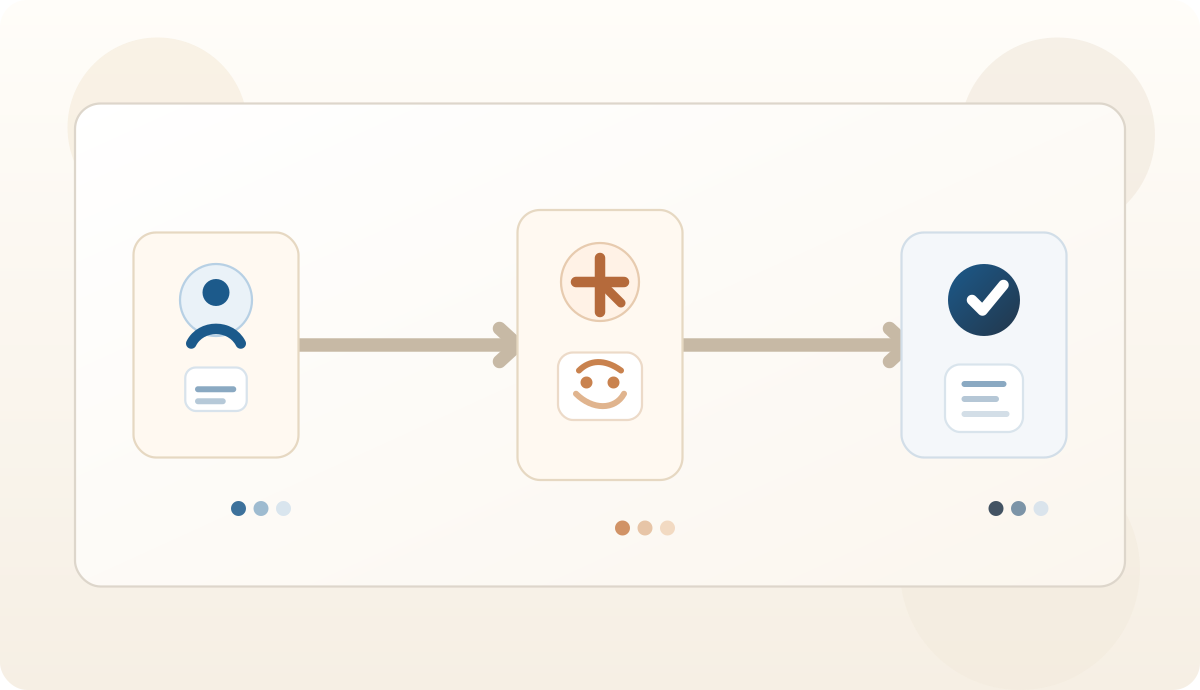
Why rehabilitation progress can still be consistent with TPD
Work conditioning is generally designed to test tolerance and build function in a controlled environment. It is not always designed to prove open-market employability. Decision-makers often look at how you participated, not only whether you attended.
- Controlled setting: sessions may be supervised by allied health teams with immediate adjustment options.
- Short duration: performance over a brief program may not demonstrate month-after-month durability.
- Graduated workload: tasks are often staged and paced, unlike ordinary role expectations.
- Therapeutic objective: the goal can be recovery assessment, not proof of full vocational readiness.
- Accommodation dependence: if participation depended on substantial supports, this should be clearly explained.
In practice, a short program can show motivation and compliance while still supporting a finding that sustainable work capacity was not restored.
Policy wording still controls the claim outcome
TPD claims are not decided by labels like “rehab completed.” They are usually decided by policy language and evidence quality.
Own occupation definitions
The issue is commonly whether you can return to your pre-disability occupation in a practical and sustainable way. A brief conditioned program may have limited weight if your original role had heavier physical, cognitive, or reliability demands than the program tested.
Any occupation definitions
The question is broader, but sustainability and real-world employability still matter. Assessors may test whether your restrictions still prevent suitable paid work for which you are reasonably qualified by education, training, or experience.
Either way, the strongest files explain why observed program capacity did not translate into stable labour-market capacity.
What assessors usually test after work conditioning
Reliability across full weeks
Occasional task completion is different from predictable attendance and performance over normal working weeks. Repeated absences, shortened sessions, or variable function can be more important than isolated good days.
Sustainability after support reduces
Some claimants perform acceptably while support intensity is high, then deteriorate when sessions increase or supervision falls. If that pattern occurred, document it clearly.
Carryover impact outside sessions
Delayed pain flares, post-exertional fatigue, concentration decline, or medication side effects after sessions can show that measured participation was not sustainably transferable to paid work.
Duty realism
If program tasks were narrower than ordinary employment tasks, the evidence should say so. A mismatch between therapeutic duties and real-world role demands is common.
Chronology consistency
Dates and capacity descriptions should align across medical records, rehabilitation reports, and any workers compensation/income protection documentation. Inconsistency often creates avoidable delay.
Evidence structure that usually improves decision quality
For this scenario, a structured evidence pack is usually safer than a loose collection of reports. Consider preparing evidence in bundles:
- Program context bundle: referral reason, program objectives, session schedule, progression rules, and supervision model.
- Attendance and tolerance bundle: attended sessions, missed sessions, modified activities, stop points, symptom spikes, and recovery time.
- Functional limitations bundle: practical restrictions in sitting, standing, lifting, concentration, pace, and repeatability.
- Medical interpretation bundle: treating GP/specialist commentary on why short-term gains did not establish durable work capacity.
- Post-program trajectory bundle: what happened after completion—whether attempted duties failed, treatment escalated, or restrictions remained.
- Consistency bundle: stable chronology and factual wording across TPD forms and any parallel systems.
This layout helps decision-makers assess function and sustainability rather than over-weighting a single completion label.
Common mistakes that weaken claims
- Overstating completion: describing program completion as a full vocational success when records show modification and instability.
- Under-describing supports: omitting supervision and adjustments can make capacity appear stronger than it was.
- Ignoring after-effects: if symptom rebound occurred after sessions, it should be documented with dates and clinical notes.
- Date mismatch: inconsistent timelines between medical and insurer/trustee forms trigger additional requests and delay.
- Diagnosis-only framing: TPD analysis usually needs functional and occupational impact, not diagnosis labels alone.
- Premature lodgement: lodging before key reports are ready can produce avoidable delay loops.
A practical way to describe the work-conditioning period
A three-part narrative often works well:
- Rehabilitation attempt: you engaged in good faith with a structured program.
- Observed constraints: despite participation, reliability and/or sustainability limitations remained clear.
- Current capacity position: treating evidence supports ongoing limitations under the policy test.
This approach recognises effort while avoiding the impression that therapeutic participation equals durable employability.
What an insurer or trustee may still need answered
When a rehabilitation report says a short work-conditioning program was completed, the next questions are usually practical rather than theoretical. The trustee or insurer may ask whether the program tested the same duties, hours, pace, supervision, and reliability expected in the work you could realistically do. A useful response should avoid arguing that rehabilitation was meaningless. Instead, it should explain what the program did and did not prove.
- Hours and frequency: did the program show capacity across ordinary weekly hours, or only short supervised sessions?
- Real role comparison: were lifting, sitting, standing, concentration, driving, customer contact, or production demands comparable to paid work?
- Support dependence: did the result depend on pacing, rest breaks, allied-health supervision, task removal, or flexible attendance?
- After-effect evidence: did pain, fatigue, medication effects, anxiety, or reduced concentration appear later that day or over following days?
- Medical interpretation: do treating practitioners explain why the observed progress did not equal durable capacity under the TPD definition?
This kind of answer-ready structure helps the page, and the claim file, separate a genuine rehabilitation effort from proof of sustainable employment. It also gives doctors a clearer prompt than a general request for another support letter.
If you also have workers compensation or income protection claims
Parallel claims are common. Different schemes may apply different legal tests, but the factual timeline should usually remain consistent. Keep one master chronology and cross-check all key forms before submission.
- program start/end dates and attendance pattern;
- tasks attempted versus tasks removed or modified;
- flare/relapse periods and treatment changes;
- reasons progression was limited or ceased;
- current restrictions and prognosis wording.
Clear consistency reduces avoidable credibility disputes and repeated information requests.
Pre-lodgement checklist for short work-conditioning cases
- Confirm the exact TPD definition and date logic under your policy.
- Prepare a date-accurate chronology from referral to current status.
- Collect rehabilitation reports showing supervision, modifications, and attendance pattern.
- Ask treating doctors to address reliability and sustainability, not diagnosis alone.
- Document post-session and post-program symptom effects.
- Check consistency across TPD, workers compensation, and income protection materials (if relevant).
- Resolve obvious evidence gaps before lodging where reasonably possible.
Preparation does not guarantee an outcome, but it usually improves clarity and reduces avoidable delay.
Worked example: when a short program does not prove durable capacity
A claimant with a physically demanding background completes a six-week work-conditioning program after injury. On paper, the program is marked “completed.” But the detailed records show multiple reductions in session intensity, frequent post-session pain flare, and increasing recovery time between sessions. Attendance is technically adequate, yet output quality and repeatability decline in later weeks.
After the program ends, the claimant attempts limited duties but cannot maintain predictable attendance over the following month. Treating doctors document that activity tolerance is inconsistent and dependent on support conditions unavailable in ordinary employment. In that scenario, “completion” still sits alongside evidence of unreliable and unsustainable function.
This is why chronology detail matters. A decision-maker reading only the final completion note may draw a very different conclusion from one who sees the full pattern from week one to post-program deterioration.
If your claim is delayed after rehabilitation records are reviewed
Delay does not always mean refusal is likely. In these matters, delays commonly occur because assessors request clarification on support levels, post-program capacity, or inconsistent wording across records. A structured response can reduce further drift:
- answer each request with dated, document-linked chronology points;
- ask treating doctors to explain sustainability limits in plain functional language;
- provide context for attendance variability and symptom rebound;
- reconcile any wording differences between channels before sending updates;
- avoid emotional overstatement and keep responses evidence-led.
Where decision correspondence over-relies on rehabilitation completion language, targeted clarification can be important: what supports existed, what tasks were excluded, and why those conditions were not transferable to ordinary paid work.
FAQs
Does finishing a short work conditioning program disqualify me from TPD?
Usually no. Completion can be one data point, but decision-makers generally assess whether you have reliable, sustainable work capacity under policy wording.
What if I could do sessions but not sustain ordinary work afterwards?
That pattern can still support a claim. Document attendance pattern, symptom rebound, and treating-doctor interpretation clearly.
Do I need to disclose all program accommodations?
Yes. Transparent reporting of supervision and modifications usually helps avoid misinterpretation of capacity.
Can insurers rely heavily on rehabilitation completion language?
They may try to. A stronger response is detailed evidence showing why the program context did not establish durable paid employability.
Should I wait to lodge until every report is finalised?
Timing is case-specific. In many matters, a short preparation period to finalise key evidence improves claim quality and reduces delay risk.
Important: This page is general information only and is not legal advice. Eligibility and outcomes depend on policy wording, evidence quality, and personal circumstances.
Helpful source and related guides
For the policy-definition side of a TPD claim, the starting point is usually your superannuation fund and insurance policy wording. Public background on insurance through super can also be checked through Moneysmart's insurance through super guidance, but your own policy and evidence remain decisive.
Can I claim TPD after unpaid trial duties? · Can I claim TPD after short return to work with reduced duties? · Can I claim TPD after employer-modified duties relapse? · Can I claim TPD after a graduated return to work failed? · Evidence required for a TPD claim
Need help presenting rehabilitation evidence clearly?
TPD Claims (Stephen Young Lawyers) can help you structure chronology, medical evidence, and correspondence so a short work-conditioning program is presented accurately and in context.