
Can I claim TPD after sporadic light duties in a family business?
Short answer
In many cases, yes. Occasional light tasks in a family business do not automatically prove that you can sustain suitable work in the broader labour market. A TPD claim usually turns on the policy wording, the relevant assessment date, medical and employment evidence, and whether the activity showed reliable work capacity in ordinary employment conditions.
The safest way to present this issue is to disclose the family-business activity clearly, then explain the accommodations, irregular attendance, reduced productivity, symptom flare-ups, and reasons the arrangement was not sustainable. If the work attempt failed or only happened because relatives absorbed the commercial risk, that context should be visible near the front of the claim file.
What this means for a TPD assessment
Decision-makers should not assess family-business duties as if they were ordinary competitive employment without checking the context. The practical question is usually whether the claimant could perform suitable work with predictable attendance, useful output, and tolerable recovery demands over time. That is different from asking whether the person could complete a few safe tasks when symptoms allowed.
- If duties were irregular: show the pattern of missed shifts, shortened sessions, cancellations, and recovery days.
- If relatives made accommodations: explain flexible hours, rest breaks, substitution by family members, and removed tasks.
- If the work was not commercially realistic: record why a non-family employer would probably not have accepted the same attendance, pace, or supervision needs.
- If other claims exist: keep the factual history consistent with workers compensation, income protection, Centrelink, and medical records.
For broader context, compare this page with the guides on own occupation and any occupation TPD definitions, what evidence is needed for a TPD claim, and checking whether a TPD file is ready to lodge.
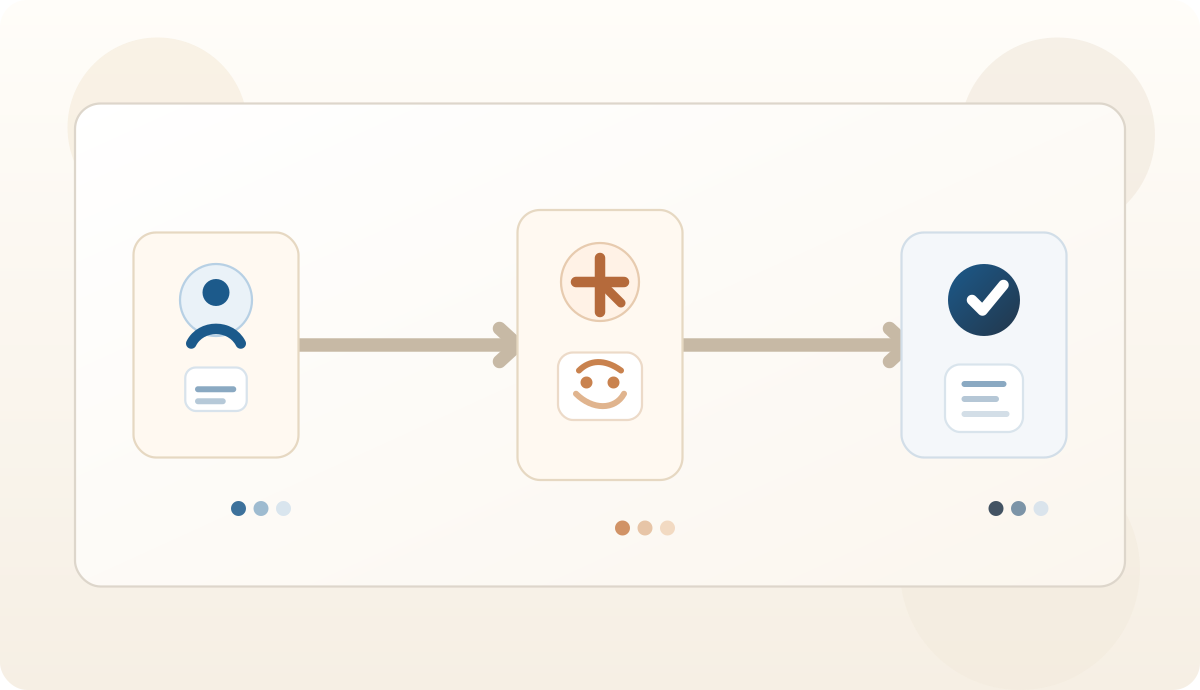
Why family-business work can be misunderstood in TPD claims
Many claimants help relatives after illness or injury because the environment feels safer and more adaptable than open-market work. Family businesses often provide informal accommodations that ordinary employers cannot offer: slower pace, ad hoc attendance, task switching mid-shift, immediate rest breaks, or reduced productivity expectations. None of that is inherently wrong, but it can be misunderstood if not explained clearly.
Insurers and trustees may look at any work-like activity and ask whether it indicates capacity. That is a reasonable question. The problem is when the context is stripped away. A file that simply says “the claimant worked in a family business” can look very different from a file that explains “the claimant attempted irregular, low-demand duties with substantial support and still could not maintain attendance or output.”
A strong claim does not hide work attempts. It explains them accurately. In many cases, these attempts show motivation and rehabilitation effort rather than durable employability.
The core legal issue: sustainable employability, not occasional participation
Most TPD disputes in this scenario revolve around one issue: whether a person could perform suitable work consistently over time. Sporadic participation can coexist with permanent impairment where:
- attendance is irregular and unpredictable,
- tasks are heavily restricted or constantly adjusted,
- work tolerance drops after short periods,
- symptom flares require frequent recovery days, and
- output is materially below normal market expectations.
That distinction matters across both own-occupation and any-occupation style policy tests. The wording differs by policy, but in practical terms decision-makers still examine functional capacity in realistic employment conditions.
How policy wording should guide your evidence
TPD outcomes are policy-driven. Before preparing documents, map your evidence to the actual definition and relevant dates under your cover.
- Own occupation framing: explain why core functions of your pre-disability role were not sustainably possible, even after attempted adaptation.
- Any occupation framing: explain why family-assisted light duties did not translate to reliable capacity in roles suited to your background, training, and experience.
- Date control: ensure timelines, medical reports, and employment records align with waiting periods, cessation dates, and policy milestones.
A frequent defect is sending large bundles of records without definition mapping. Volume is not strategy. Relevance and alignment are what move decisions.
Evidence architecture that usually helps in this scenario
Build one clear chronology
Build a single chronology from first incapacity to cessation of family-business duties. Include attempted shifts, cancellations, flare days, treatment changes, and reasons for stopping. A clear chronology often prevents unnecessary information requests.
Explain the real family-business duty context
Document what “light duties” actually meant: reduced lifting, short task windows, no customer pressure, flexible start times, ability to leave when symptoms worsened, and reliance on others for completion. Precision matters more than broad labels.
Show the real attendance and output pattern
Keep records of missed days, shortened sessions, incomplete tasks, and recovery burden after activity. Capacity is usually tested over weeks and months, not isolated good days.
Use treating evidence that focuses on function
Medical reports should explain practical limits (endurance, concentration, pain/fatigue cycle, side effects, relapse triggers) and why supportive family settings did not equal open-market work capacity.
Keep cross-scheme records consistent
If you also have workers compensation, income protection, or Centrelink records, factual consistency is critical: dates, symptom pattern, duty tolerances, and reasons for failed work attempts should align unless differences are explicitly explained.
How assessors often test family-business cases
In practice, decision-makers usually test five areas simultaneously:
- Reliability: could the claimant attend predictably enough for real employment?
- Durability: could activity be maintained without repeated relapse cycles?
- Productivity: did output approach normal role expectations?
- Transferability: would this level of function likely hold in non-family workplaces?
- Credibility: do forms, medical reports, and third-party records tell the same story?
If your file directly answers these tests, assessments are often clearer and faster.
Common mistakes that create avoidable problems
- Minimising or hiding family duties: non-disclosure can damage credibility if records emerge later.
- Overstating duties: describing occasional help as stable employment can be used against you.
- Missing accommodation detail: failing to show how heavily the role was adjusted.
- No sustainability analysis: focusing on “what I could do once” rather than “what I could do repeatedly.”
- Fragmented chronology: inconsistent dates across forms, reports, and submissions.
- Uncoordinated parallel claims: inconsistent capacity descriptions across schemes.
Practical 30-day preparation plan
- Week 1: gather all relevant records (duty notes, calendars, messages, attendance logs, medical certificates, treatment updates).
- Week 1–2: create a dated timeline of activity, symptom changes, and recovery impact.
- Week 2: obtain treating reports focused on function, reliability, and sustainability.
- Week 3: compare wording used in any active workers compensation/income protection/Centrelink process.
- Week 4: finalise a concise indexed submission tied to the policy definition.
This sequence is designed to reduce back-and-forth and avoidable delay, not just to increase document volume.
Worked example (general information only)
A claimant with chronic lumbar pain and medication side effects helps at a relative's retail store. Duties are limited to occasional stock checking and short paperwork tasks, usually 1–2 hours at a time. Start times vary according to symptoms. On many weeks no attendance occurs. When activity increases before holiday periods, pain flares and recovery takes several days. Family members complete customer-facing tasks and heavier work.
In this pattern, “some work activity” does not necessarily show sustainable employability. It may instead demonstrate limited, support-dependent function with poor reliability under even modest demand.
If your claim is delayed or challenged
- Request the exact issue being disputed (for example, “capacity inferred from family-business duties”).
- Respond with targeted evidence about accommodations, attendance variability, and post-activity recovery burden.
- Re-map all key facts to policy wording and relevant dates.
- Correct factual misunderstandings quickly, especially around hours worked and role expectations.
- Keep responses focused and structured; broad duplicate bundles often slow assessment.
Quality-check questions before lodgement
- Have you explained why family-based support is not representative of ordinary employment?
- Can an assessor follow your chronology in one read?
- Do medical reports address endurance and sustainability, not diagnosis alone?
- Are attendance records and statements consistent with each other?
- Do parallel-claim documents use compatible functional language?
- Have you clearly identified the event that ended the work attempt?
How to brief doctors and third-party witnesses effectively
Many otherwise strong files fail because the right people are asked the wrong questions. Treating doctors, family members, and former supervisors can all provide useful material, but only if their evidence addresses decision issues directly.
For treating clinicians, ask for practical function analysis rather than broad conclusions. Useful reports usually explain tolerated hours, pain or fatigue escalation after activity, cognitive effects from symptoms or medication, expected recovery time, and whether capacity is predictable enough for sustained attendance. Where possible, reports should distinguish between what is possible on a single better day and what is realistic week after week.
For family-business witnesses, objective detail is usually stronger than advocacy language. Helpful statements often cover:
- what tasks were attempted and which tasks had to be removed,
- how often shifts were shortened or cancelled,
- what support or substitution by relatives was required,
- how symptom flare affected attendance and output, and
- why the arrangement was not commercially sustainable.
When witness statements and medical reports tell the same functional story in different words, assessors can usually follow the file more quickly. This is one of the most practical ways to reduce avoidable delay and confusion.
FAQ
Does helping in a family business automatically defeat a TPD claim?
No. Occasional, support-dependent duties do not automatically prove durable work capacity.
Should I disclose family-business duties in my claim forms?
Yes. It is usually better to disclose and explain the limitations than to omit the activity.
What if I could do only a few tasks on good days?
That can still be consistent with TPD if overall reliability and sustainability were poor.
Do I need evidence from family members?
Practical third-party evidence can help when it objectively describes attendance, accommodations, and functional limits.
Can inconsistent wording across different claims hurt my file?
Yes. Even where legal tests differ, factual history should remain coherent.
Important: This page is general information only and is not legal advice. Eligibility and outcomes depend on policy wording, evidence quality, and individual circumstances.
Related guides
Can I claim TPD after trying casual or gig work? · Can I claim TPD after intermittent work-from-home duties? · Can I claim TPD after a host-employer placement fails? · Evidence required for a TPD claim · How TPD claims work
Need help presenting a family-business work-attempt history clearly?
If your record includes irregular light duties, fluctuating symptoms, and mixed documents across schemes, careful preparation can reduce avoidable delays and misunderstanding.